Monday, 22 June 2015

Let’s not be too precious…

Let us not be too precious about things. They go to waste, they break, they seemingly miss their moment
(Kintsukoroi)
they are missed, or mistakingly opened, they spoil, they happen, they are no longer here.
When did you have them? What was it like? What are you like?

I brought home a sliver of a ripe Langres. A washed rind cheese, it has the texture of clotted cream
with addition of self settled curd resistance. The cheese was so delicate and rich that a sliver was all that was left of the tastings and the tower of Langres that had been behind it that day. I brought it home and was skipping through recipe books. The Langres was waiting for its fate when I surprised both it and myself by popping it on a cracker and into the oven for a minute, and then into my mouth. Amuse bouche, amuse gueule, amused fate.

Last weekend I (generously) invited a friend and myself to supper at my mother’s home. He went to pains and displayed ingenuity to twice decant the wine he brought; he only looked at the main course when he settle the readied bottle near the warmed
plates. Tuna and Brunello di Montalcino anyone? At least the tuna was fresh but Brunello is a stud thoroughbred of the Tuscan wine world. My friend just found out he had entered his horse into a beach ride. The gesture was generous; the wine dry and rich, its restrained presence like a withholding but near friendly handshake from an aristocrat. Perhaps it was not the best moment for a Brunello but it was a great one for me.
Montalcino, Tuscany


I don’t know if I believe in special occasions or perfect moments. I do believe that we make occasions special and that if we wait for the right moment, there will almost always be factors that supersede the gift that you are bringing to it. Judge Roy Bean (aka blue eyed Paul Newman) buys his lover the music box she once asked for but arrives with it to find her on her deathbed- not to be dramatic or anything. Our gestures are never lost though their meaning might become a contributory to, rather than the whole.

Don’t make too much of the thing, it has been said that when Louis XVI was fleeing Paris for Austria with Marie Antoinette and family, he delayed to stop for some wine and a piece of Brie de Meaux (French legends, I add). This hunger, together with the accurate likeness of the king upon the 50 livre assignat allowed time and opportunity for him to be recognised, caught, brought back to Paris and duly guillotined. Perhaps he should have skipped lunch.


What follows are some recipes that show no awe for their ingredients, just understanding and appreciation.

My decadent Aunt occasionally makes a, 'She loves this guest' Veal and Mushroom dish and uses Delamain Cognac. This was the closest I could find to her recipe – that is from Martha Stewart makes me laugh.
  
Two separate acquaintances (who in their moment of sharing nearly become untrustworthy) spoke of Appenzeller Cheese as a topping for their pizza. Strong and scented and a little expensive, I doubted their rational and their taste. Now I just question my imagination.

By all means, trade around the ingredients for Heston Blumen-No-Budget’s recipe, but Macaroni and Cheese can be elegant, not just comfort food. Thank you Heston. Apologies if I have mentioned this before, I like it that much.


Finally, Remember our Latin forebears…. They have beautiful cheese, they make beautiful things with it and sometimes they just eat it. Parmigiano-Reggiano, Taleggio, Mozzarella di Bufala, they are all able to stand by themselves but each are also such excellent companions and company. Parmigiano-Reggiano on pastas always but also on a cheese boards, maybe with honey or a balsamic reduction. Taleggio or taleggio on polenta crust (from Ottolenghi). Mozzarella di Bufala with salt, graduate to Caprese or squished into a rubbed garlic toastie.


Precious but not...

Thursday, 16 April 2015

Americans Say Cheese


When you think of the USA you may not immediately think cheese. You may not even think food - after all the infamous twinkies are predicted to live beyond doomsday. 

It is a strange thing to consider that many US citizens were raised on “cheese products”, where the usual line up of ingredients for cheese is more colourful, imaginative and a little more exploratory of your scientific culinary cupboard. I am a little biased and prefer homemade terroir to Frankenstein terror. As with most topics in the U.S, there is an increasing pull going both ways.

US companies have put cheese in a can (Gee Whiz it’s Cheese Whiz), made it sprayable (Easy Cheese, do you believe it is cheese?), they’ve wrapped up the cheese equivalent to a hot dog in plastic packs (cheese slices with an ‘attractive’ light orange hue, Kraft ’singles’, single for ever more). The shape is, in theory, convenient for sandwiches, in practice, for folding it into cheese chimney stacks. Most essentially, the 1928 miracle of Velveeta, a nutritional cheese product that does the opposite to cheese when heated: it does not melt.  It, like a good face-lift, stays soft and supple under a variety of tested conditions.  How convenient. Oh convenience.

I do not like my complexity to come from a can. The US had some promising farmhouse cheese at the
turn of the twentieth century. Anne Pickett of Wisconsin would pool neighbours milk together to make cheese and then share it back out. Women making cheese and homestead industries were common. It was farmhouse, it was community, there was taste, it was real… and then came industrial innovation, railroad and war with unperishable needs. Won over to this new exciting technology and promises of science, fashion and convenience, farmhouse cheese failed to prosper amongst the general american public.


Thankfully convenience is not as attractive as it used to be, subtle taste buds are returning with travel and, one suspects, the rise of other better quality products raising palates and tolerance. With a greater vision, style arrives.

U.S. artisanal cheese is once more on the up.  Cheese with perishable nuances is now a good thing. There are limitations but there is much progress, massive like. If ideas are contagious, this is one that has caught on from coast to coast.

Everona creamery, on the East side, in Virginia, produces some subtle, delicately rich, Ewe’s milk cheese. It began when a doctor got a sheep dog at a fair and needed some sheep to keep it busy. Now they produce over five types of cheese, the soil is flourishing, the practices, medicinal and food health, continue, the sheep have multiplied and the original dog has retired.

Cypress Grove of west coast California import and make cheese. Mary Keehn began with a few goats gathered from a neighbour’s farm for milk and a decision to turn her excess milk into cheese - little did she know. One Humboldt Fog later she persisted through palates unaccustomed to goat cheese and produced, until she sold the business in 2010, one of America’s most well known farmhouse goats cheese. 

There is an element of invention that I admire in the US. Americans often have a, (in Irish) “give it a go” attitude. Americans like experiments. Everona Creamery once had an interesting cheese that was made by grating the older cheese into the young curd, thus having two ages in one. Or there are experiments like Rogue River Blue, a cave aged blue wrapped in grape leaves, which have been soaked in a local pear “eau de vie". As the saying goes and sometimes applies, It will knock your sock off. American are inventing micro traditions.

On Brie, US does not allow raw milk cheese under sixty days but pathways to soft cheese taste have been forged. Cowgirl Creamery of California have some delightful ones. The washed rind Red Hawk and the bloom rind Mt. Tam., both triple cream, have flavours that settles like a pioneer on young tongue. Complexity? Perhaps. Character? Plenty.

 The end justifies the means or the means explains lead to a particular finish..

More temptations:


Let us be fair to the history and the use of American Cheese, there is a comfort factor that is behind comfort food.  Martha Stewart, the blonde Mary Poppins of the kitchen, may never buy Velveeta, but she is not above sneaking a slice of it.  The best comfort food in the US reminds me of its vast landscapes. They incorporate a few major elements – Big Sky of Texas, Prairies of endless grassland,
Suburbs or pavement. lawns and houses, New growth Forests, New York (it is also a state though sometimes we forget); a few strong elements but rarely many at once. Macaroni and cheese, grilled cheese sandwiches, Pimento cheese, sure as hell sharp cheddar, and the cheese burger.


It is a lot of comfort food – there are the easy tastes in generous amounts but there are also the smaller producers coming forward with cheese that speaks of the land and the invention and resilience of the people living on it.

When visiting the US,
Say cheese…Real cheese
Please.


Tuesday, 10 March 2015

Going Dutch. Going for Gold.

It is a strange thing this air we breathe and the soil under our feet. We do not, initially know what is in them; they are just firmly or transparently there.  Eventually we learn that the air contains nitrogen, oxygen, carbon dioxide, wind, perfumes redolent of the world, memories and complexities and that the soil is rich with the past, with hummus, stones, so many stones, clay, worms, mycelium, roots and lost treasures. 

What therefore one wonders, goes into our cheese?  We accept and hope that there are usually milks from cows, ewes and or does (female goats), seasons, grass, sunshine, midnight raids into neighbour’s garden plots, moulds, bacteria, linen wraps or wax seals, the differences of the processes of production. But beyond processes and terroir, there is still more. Like trees to Carbon Dioxide and into fresh air; there is a strong element of Dutch that goes into making that Irish farmhouse cheese. 


Go into a cheese shop to taste some of the locals and you would be hard pushed to avoid either a gouda or a Dutch hand, we even have a half-Dutch (at heart) cheese monger where I work. But let us be efficient, let us be appropriate to our topic, let us begin.

Marion Roeleved, cheese maker of Killeen Farmhouse, is a woman whom I admire as much as I enjoy. Last time I saw her she walked energetically and purposefully into the shop saying, “I have come to see my cheese.” Yes, we are taking good care of your children. 

Marion came to visit Ireland and met a goat farmer named Haske. Need we suggest more? Marion now makes a number of different cheese; she uses the milk from their own goat herd, from local cow herds and on behalf of a few milking sheep farmers. Her cheese are consistently good; they remind me of a well done cheese and ham sandwich – simple perhaps, but simply so satisfying. I also like that she branches out beyond the traditional wheels of gouda. I wonder if it is the affect of being in Ireland or an off-shoot of the adventurous spirit that moves to rural Ireland. Along with her multiple Gouda’s and some fresh cheese, Marion also makes a raw milk goat’s cheddar, Kilmora (‘Irish Emmental’ style) and Cais na Tire, a sheep milk cheese that reminds me of a delicate and textured young Manchego.

Onto the Willems family of Macroom Co. Cork... and that Ireland is a small country. In the 1990’s my brother’s (Dutch) French teacher drove around with wheels of his compatriot’s cheese in his boot, stopping between jobs to promote it to restaurants. The next generation of Dicky Willems has taken over but the tradition rocks on. The Willems left their nightclub business in Rotterdam to pursue idyll rural life in Ireland. A chance acquaintance with a dairy cow and vacuum of goudas available locally (Cork countryside in the1970’s), along with a Dutch attention to detail led to the development of Coolea. The Willems now concentrate on the cheese making and trust, with an attentive eye, their neighbours for the milk. This is what clearly happens when efficient adventurous people of a Dutch background look for a change in scenery.

Goudas I have known; if the people are not Dutch, their cheese style certainly is. Clonmore is a goat gouda made by Tom Beggane in Newtownshandrum, Co. Cork with milk from his herd of very privileged goats. Organic Mossfield Gouda comes from Irish, German descendent, Ralph Haslam of Co. Offaly at the grateful foot of the Slieve Bloom Mts.  Rose Van de Graaf and Roches Van de Vaart of the Oisin farmhouse in County Limerick (I am not sure where they are from, but I do wonder) import Dutch cheese (including some organic goat and blue goat gouda see On the Pig’s Back in Cork) and a few Ages Gouda Rounds for the laugh.

Ireland’s famous Cashel Blue owes a fair bit of its blue veined backbone to the labour of Geurt van denDikkenberg who took over for Jane Grubb in the early 1990’s as the master cheese maker when her own back began to tire.

No mention of the Dutch should go without homage to the makers of Mine-Gabhar and Mine-Croghan, goat cheeses (not Goudas) made by the Van Kampens, from Ballinadrishogue, Co. Wexford. Homage because it was an adventure of twenty plus years and a fantastic cheese It is sorely missed by those who have had it, missed like the Irish in America
who, every morning, must miss our salty rich butter and real unsweetened bread. In a land without much spare money, people still knew it was worth saving their pounds for a round of the perfection of mine-gabhar. Luc began it all as a hobby while pursuing being an artist and minding a woman’s goats; as you do. Their processes were scrupulous and the cheese gold. 
Doubt the writer? Homages here: 1 2 3 4

And so in Irish cheese we have a canal of Dutch history. Even the industrial Dubliner cheese (note it is not labeled cheddar) has a Gouda starter culture. Is it the Nederland’s people's hundreds of years of eating cheese?  The former mercantile empire continuing to spread their riches? The plain good practicality of these wax sealed curds? Or the fine attention to detail and simply good processes that Holland and the Dutch are replete with? …. Or is just the luck of the Irish?

Sunday, 25 January 2015

Not all Stiltons are created equal….or simply. PART II

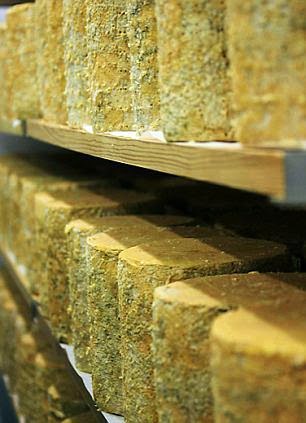
Proper form. I have a great deal of admiration for the makers of Stilton; a preferred creamery in Nottingamshire would not release its Stilton, even though it was Christmas time and the Irish were out, not because we were Irish but because the cheese was too young. I like it when nature dictates to man.

This post, I should explain results from an interaction with my mother. She seemed to avoid buying cheese from me. I brought her home a block of Stilton one Christmas to discover that she had bought a quarter round somewhere else. Pints to a pub, I felt a little too late to have been of service.  It was after Christmas when she unexpectedly asked me why our Stilton should be so much better or any different to hers? A reprieve, I clarified that not all Stiltons are created equal and most assuredly, not the same.  There is more than one producer of Stilton and within that a range of good, particular, better to best.  I shall remain quiet about my bias, but now to the creameries.

Research indicates that there are currently six creameries making Stilton Cheese. I thought I knew which Stilton was my favourite but now I am not so sure – some of the stories add charm to the cheese and clarify the lack of, or plentitude of encounters.  Stilton must be made with pasteurized milk, in and from the counties of Derbyshire, Leicestershire or Nottinghamshire, the cheese be unpressed and formed in a cylindrical shape, the crust natural and the blue a result of piercing and not inoculation - the remaining differences lie in the touch of the hand.

The Creameries:
Cropwell Bishop, family run, they gave up their larger enterprise, Somerset Dairies, to focus on Stilton
making in Nottinghamshire. Their milk pools comes from 16 farms. Cropwell Bishop’s Stilton was the first and only Stilton to be served on the Concorde. They recommend it trying it with honey and walnuts.

Long Clawson of Leicestershire  have been all about Stilton for over a hundred years. There was a brief stint during the War when rationing, not reason, dictated that they had to make cheddar. Their milk pools comes from some 43 farms.

Tuxford & Tebbutt, also of Leicestershire with a long history of making cheese, Melton Mowbray’s pork pies, and gentlemen’s suit (does anyone see the expanding bias?). They let go of the other 
industries to focus on cheese making. One of the largest exporters of Stilton, it has been taken over a few times, at one stage by Milk Line, it is now owned by the very large cooperative Arla, a subsidiary on the international milk focused cooperative Arla based in Denmark.

Webster’s Dairy of Saxelbye, near Melton Mowbray, Leicestershire is a small operation run by the
Webster sisters, if you were to call the creamery I think that one of them might even answer the phone. It is a small operation but it has a following and much of their cheese is gone before it even has an opportunity to rest on fair Albion’s soil. Two sisters began the business 150 years ago, there were some brothers in between and now two sisters are in charge again. Elizabeth Scarborough might smile. I would like to taste their Stilton.

Hartingdon Creamery, Pikehall – the only makers of Stilton in Derbyshire. The Long Clawson Dairy
closed down in 2009 and these Magnificent Five, two cheese makers and three cheesemongers (two businesses) are taking up the Stilton standard for their county. The business is beginning, they have experience, they need time and support while they develop their market. Does anyone want to do a cheese class with them?
Colston-Bassettof Nottinghamshire, have been championed by Neal’s Yard as their only Stilton for the past 30 years. The cooperative was established in 1913 after a local doctor encouraged the farmers to pool their milk resources and add value to it by making cheese. Initially cheddar happened, Stilton in 1920, cheddar rationing of the war took back the cheese line but over the 1950’s the creamery turned its focus solely, thankfully back to the blues.  The original 16 farms have been consolidated into 4, but it is the same land, the curds are still hand ladled and the cheese is terrific.


Hints may have happened but it could be fun, and an accomplishment, to line them up side by side, each bought as choice samples of that creamery, and try them with friends. What sweet dreams would follow?

Recipes:
Heston Blumenthal’s, Stilton on Chocolate Biscuits with Port Reduction


Eccles Cakes and Potted Stilton (Heston Blumenthal)

Tartine, with or out without pears. 


Stilton Pairing:
Port, the majority write Ruby some say Tawny
Sherry, Amontillado is more commonly praised but some staunch defensives for Olorosso
Close your eyes and guess.
Wines: Recioto, Tokaji, Icewine, Banyuls
Sauternes or, generally late harvest German or Austrian White Wines.


Thursday, 22 January 2015

Not all Stiltons are created equal….or simply. PART I

I admire a country that takes a food that radiates out from its heart with matured blue green mould and names it the King of the Blues (but never les Bleus mon cher Roquefort). In what looks to be a well chosen English meal, in 1996 Stilton was the first cheese and amongst the first foods, Orkney Lamb, Jersey Potatoes etc to be granted PDO status in Britain.

Do origins matter? How wonderful are accepted myths?
A series of contradictions behind this wonderful cheese, it is English so are we surprised?

Much about the cheese that has been protected and promoted has so little to do with the cheese and the consumption of it. 

Point 1. Stilton village is in Cambridgeshire. Stilton cheese may only be made in the counties of Derbyshire, Leicestershire and Nottinghamshire, of which Cambridgeshire is not one.

Point 2. Legend: Stilton was thought to have come from Quenby Hall in Hungarton village (great place names over there in Britain), near Melton Mowbray (see) in Leicestershire. The tale tells that a blue cheese was made by the housekeeper Elizabeth Scarborough and sold exclusively by her son-in-law, Cooper Thornhill at The Bell Inn from 1730 on, in Stilton, on the North Road leading, propitiously to London.

Reality: Subsequent arguments have shown that local cheese tended to be sold locally (see map above), that Stilton village had its own recipes for creamy blues and there was record of Stilton's blue cheese prior to 1730.

"Daniel Defoe, in his 'A tour thro' the whole island of Great Britain' of 1724-27 has; "we pass'd Stilton, a town famous for cheese, which is call'd our English Parmesan, and is brought to table with the mites, or maggots round it, so thick, that they bring a spoon with them for you to eat the mites with, as you do the cheese."
Next time you are given a Stilton Spoon,  will you say thank you?

Point 3.The Protected Stilton recipe is made with pasteurised milk. Stilton, in all of its debatable origins, must have been made with raw milk; pasteurisation was formalised by Louis Pasteur later on in the nineteenth century. When the PDO was introduced in 1996 the legislation protected it as a pasteurised blue cheese.
There is nothing wrong with my milk

Point 4. Joe Schneideer and Randolph Hodgson are making Stichelton, an unpasteurised Stilton. They use the Domesday name for the Stilton village as PDO regulation disallow them from calling it what it is.


Point 5. Stilton goes well with Port but, despite popular legend, you should never pour Port into Stilton. With hygiene and refrigeration, maggots are not the issue that they were and, look you have just wasted the Port and the Stilton.

Point 6. Despite Stilton being a favoured blue at Christmas time, it continues in its beauty well into the New Year when everyone now avoids it with resolutions to, ‘eat better’. Eat better what?

Point 7. Stilton, while traditionally blue has some relatives, Stilton White (a younger Stilton made without Penicillium Roqueforti), Shropshire Blue (orange by annatto) and some things with dried fruit, we call them eccentric relatives.  This is why people ask for ‘Blue Stilton’; no pretenders.


Stilton, Simply.


Monday, 5 January 2015

Taste Cubed, serving it up.


Taste cubed, never in cubes.

Italy, Thank you.
I have a quiet dread of cheese cubes. I guess it is now no longer quiet, I dread cheese cubes. They are acceptable, okay forgiveable, when done as samples in stores. They are there, quickly chopped, to be popped without too much thought by shopper-gatherers.  Even writing that sentence raised some of the issues in my mind – there is a haste and a lack of thought. I wish we would taste and act more carefully.

It is lovely when someone stops after they have tried a sample and goes back to search for the label. Like a bloom’s scent or the beginning of something that turns into a conversation, inhaled or begun by chance, it redirects you and pulls you willingly, curiously towards it.

Cheese tommes with their array of rinds: from bacterium linens umber reds, bright wax wraps to mottled fuzzy grey or white bloomed skins, and with their differing shapes: thick soft huge grey guilders of curds, perfect hardcore aged Dutch suns to such planetary rings that make you think of turning cart
They look like they have been bayoneted
wheels…. Becoming generic blocks of thoughtlessness thrown into a pile. It feels like Communism of the curd and I am sure their cheese was similarly good.                                                         

I don’t particularly like cutting cheese – unless it is to open it up and to encourage others to open up to it. Different guidelines would apply to different situations and sometimes you just go with what works but, to follow, here are a few thoughts to keep in mind.

Taste Cubed  
           Temperature x Aesthetics x Form
  • The longer and the larger the cheese piece, the longer the flavour will remain intact. Open sides are like pores from which their quality will seep. 
  • Cheese should be served at room temperature, if you are wearing a jacket inside – this is not room temperature.
  • Food has less flavour when it is cold, cheese should be taken out of chilled storage at least 30 minutes before serving. The afternoon before the intended evening is also good.  My mother puts it in the pantry and not into the refrigerator (understand, cool window sill) if there are guests over for the weekend. 
  • Keep the cheese wrapped up until it is being served (and between sneaky snacks) to prevent it from drying out.
  • Soft (ripe) cheese should be given a few hours out, its flavour is invested in its fat molecules. These contract when they are cold and need to relax, to bulge or run in order to release their richness. We’ll discuss ripeness on another post.
  • Opening slices of and into the cheese should not be done too long before they are being served.
  • When cutting cheese cut according to the shape. You might do a few guiding cuts to show your guests and to encourage them to dig in. I have found that if you are serving a perfect shape or round of camembert - someone must make the initial intrusion or no one will.
from Cheese Matters, because it does
I do not like doings pieces that are too thick, not because I am mean but because the thinner slice, smaller pieces releases the flavour more delicately - who likes thick bars of dark chocolate wedged into their mouth? Squirrels.

If you must pre-cut the cheese, because flight, picnic or antipasta security will take all of your knives, be playful with the shapes and lay them out in a way that will encourage people to think of it as a treat. The cheese began pretty, keep it so. The cheese makers went to the bother, so can we.

Finally, simply, it is it not easier to just put out the cheese at the end of a long day and an extended meal and let people help themselves?